
Masterclass on Reproductive Justice: Advancing SRHR Programming and Legal
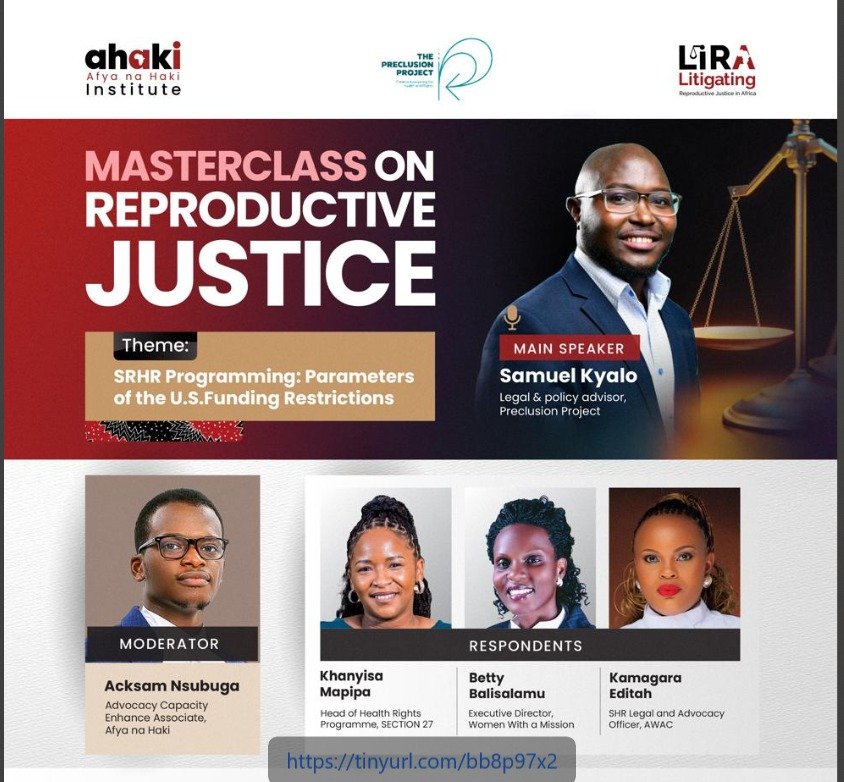
I recently participated as a respondent in a Masterclass on Reproductive Justice, a regional learning and dialogue space that brought together legal, policy, and health-rights practitioners to critically examine Sexual and Reproductive Health and Rights (SRHR) programming, particularly within the context of U.S. funding restrictions.
The masterclass was convened through a collaboration between Afyana Haki Institute, The Preclusion Project, and Litigating Reproductive Justice in Africa (LIRA)—organizations committed to strengthening rights-based approaches to health, law, and social justice.
Understanding the Context: SRHR Programming and Funding Restrictions
The session focused on unpacking how U.S. funding restrictions shape SRHR programming, legal compliance, and advocacy strategies across different country contexts. These restrictions often create operational and legal complexities for organizations working with marginalized and criminalized communities.
Through expert-led discussions, participants explored:
The legal parameters governing SRHR funding
Compliance versus rights-based programming
The real-world impact of funding policies on community access to services
Expert Contributions and Panel Engagement
The masterclass featured Samuel Kyalo, Legal and Policy Advisor at The Preclusion Project, as the main speaker. His presentation provided a grounded analysis of the legal architecture surrounding U.S. funding restrictions and their implications for SRHR work.
The discussion was moderated by Acksam Nsubuga, Advocacy Capacity Enhancement Associate at Afyana Haki Institute, ensuring a participatory and reflective exchange.
As a respondent, alongside Khanyisa Mapipa (SECTION 27) and Betty Balisalamu (Women With a Mission), I contributed legal and advocacy perspectives drawn from community-based work.
My Contribution: Legal Advocacy and Community-Centered Perspectives
Drawing from my role as SRHR Legal and Advocacy Officer at the Alliance of Women Advocating for Change (AWAC), I emphasized the importance of grounding SRHR programming in legal literacy, community realities, and lived experiences.
I highlighted how restrictive legal and funding environments often disproportionately affect structurally silenced communities, underscoring the need for:
Strong legal advocacy frameworks
Rights-affirming interpretations of policy
Community-informed strategies that reduce harm while sustaining access to services
Why These Conversations Matter
Masterclasses like this are essential for strengthening collective understanding, cross-sector collaboration, and evidence-informed advocacy. They provide safe spaces to interrogate complex policy environments while centering the voices of those most impacted by SRHR restrictions.
Engaging in these dialogues reinforces my continued commitment to reproductive justice, gender equality, and community-responsive legal advocacy.
Closing Reflection
Reproductive justice is not only a policy issue—it is a lived reality shaped by law, funding, and power. Through informed dialogue and strategic advocacy, we can continue working toward systems that uphold dignity, autonomy, and access to comprehensive SRHR services for all.